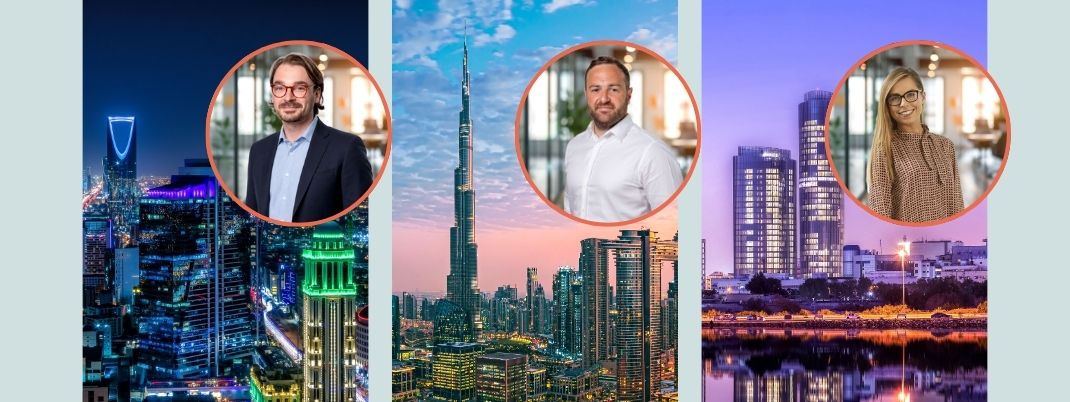
Insights from MRG’s Middle East Specialists in Riyadh, Jeddah and Dubai
Research shows that the Kingdom of Saudi Arabia and the United Arab Emirates are expected to anchor Gulf economic expansion in 2026, supported by strong private-sector activity and continued progress on national transformation programmes.
MRG’s Middle East specialists play a central role in helping organisations secure the senior talent needed to deliver on these ambitions.
Across Riyadh, Jeddah and Dubai, Matthew Donovan (MD), Stephanie Taylor (ST) and Matthew Giles (MG) lead MRG’s regional presence in arguably the world’s most exciting real estate and development region.
With extensive experience across global and regional markets, they lead teams at the centre of this growth, supporting clients through complex senior hiring decisions while building platforms for long-term impact.
Here, they reflect on leadership hiring, their evolving markets and what it takes to build trusted partnerships across borders in the Middle East.
How has your experience shaped the way you approach building relationships, establishing credibility and growing MRG’s presence in your market?
MD: Operating in Saudi Arabia, particularly Riyadh, has required a practical approach to building a team and client base. The pace of change is fast, as is the need for credibility and delivery. We have focused less on rapid expansion and more on building a reputation with a small number of high-impact clients, particularly across PIF subsidiaries, contractors, and private-sector developers. That has meant prioritising delivery capability, understanding project lifecycles in detail and being selective about where we engage.
MG: In Dubai, it is a different balance between scale and specialism. It is a mature and highly competitive market, so credibility is built less on entry and more on consistency over time. Our focus has been on strengthening relationships with key developers, investment platforms and operators, while remaining selective on mandates. In a fast-moving and relationship-led environment, trust and responsiveness are critical.
ST: From a Jeddah standpoint, while business across Saudi Arabia is relationship-driven, Jeddah requires an even deeper level of that. There is a distinct local culture, more informal, closely knit and shaped by long-standing personal and family networks, so trust and familiarity carry significant weight in how business is conducted.
MRG has a distinct global DNA shaped by its origins in London. How do you bring that approach to life locally?
MG: The MRG DNA translates clearly in Dubai, particularly through structured, research-led search processes and senior stakeholder engagement. What changes is the pace of expectation and the international nature of the market. Dubai is inherently global, so success comes from combining that structure with agility and an understanding of regional and international talent flows.
MD: That structured approach is equally relevant in Saudi Arabia. What differs is the pace, stakeholder complexity and the importance of cultural context. Success comes from combining a data-led methodology with a clear understanding of how decisions are made within the Kingdom.
ST: In Jeddah, it starts with being clear on what defines us—our values, standards and ways of working—while adapting how these are applied locally. Cross-selling plays an important role, but only once trust is established. Rather than introducing multiple services upfront, it is about delivering well first and then expanding the relationship over time.
What do you wish more global clients understood about the senior talent landscape in your market?
MD: Many global clients underestimate the constraints on the senior talent pool, particularly for client-side development and delivery roles. The scale of projects is significant, but the number of individuals with comparable experience is limited. This is further shaped by a strong emphasis on developing and retaining Saudi leadership talent.
MG: In Dubai, the challenge is less about availability and more about access. Many of the strongest candidates are already in long-term roles and are frequently approached. There is also an assumption that mobility is easier than it is at senior level. Engagement strategy and timing are often more important than the search itself.
ST: There is often a mismatch in the relevance of experience across markets. Candidates from mature markets may bring deep specialisation but lack exposure to fast-paced, build-and-scale environments, while those from emerging markets may be more adaptable but have less experience in structured organisations. Aligning these profiles with role requirements is a key challenge.
Your markets are evolving rapidly. What trends are having the biggest impact on senior hiring?
MD: In Saudi Arabia, there has been a clear shift from announcement to delivery, aligned with the evolution of PIF’s investment strategy. Earlier phases focused on vision and launch, whereas the current phase is centred on execution, cost control and programme delivery. This is driving demand for leaders with proven delivery experience, alongside continued growth in sectors such as tourism, entertainment and digital infrastructure.
MG: In Dubai, continued real estate expansion, large-scale mixed-use developments and the growth of hospitality and tourism are key drivers. At the same time, there is increasing demand for senior leaders in investment and asset management, reflecting Dubai’s position as a regional investment hub.
ST: Across Saudi Arabia, changes in compensation structures and increased local workforce participation are also influencing hiring. As expatriate packages become less inflated, organisations are prioritising regionally experienced or locally based professionals with international exposure.
Can you share a mandate that stands out for you?
MD: A recent standout has been our involvement in large-scale infrastructure and delivery programmes within Saudi giga-projects, particularly across roads and earthworks packages. These mandates are significant in both scale and urgency, requiring multiple senior hires within compressed timeframes.
MG: A recent example in Dubai involved a series of senior leadership mandates for a high-end project management consultancy supporting major developments across the UAE. The challenge was the speed required, combined with intense competition for candidates with the right delivery and client-facing experience.
What distinguishes MRG’s approach to senior recruitment in your markets?
ST: MRG has a long-established track record in the Middle East, having navigated multiple market cycles. Our sector expertise, long-standing client relationships and reputation position us as a trusted partner for senior and strategic recruitment.
MD: We approach senior hiring as a structured process rather than a CV-driven exercise. It is about precision and quality, not volume. We invest time in defining mandates, mapping the market globally and engaging candidates in a way that reflects the seniority of the opportunity.
MG: In Dubai, our global reach is a key differentiator. We consistently engage talent from the UK, Europe, North America, and the wider MENA region, rather than relying solely on locally active candidates. That global access, combined with a disciplined, research-led process, allows us to reach talent not visible through traditional channels.
What are the biggest opportunities for growth in your markets?
MD: The biggest opportunity remains within Saudi Arabia, particularly as projects move further into delivery phases. There is sustained demand across development, infrastructure and operations, alongside growing activity in adjacent sectors such as PPP, asset management and FM.
ST: In Saudi Arabia, diversification is creating opportunities across integrated consumer and digital ecosystems. Retail, e-commerce and logistics are evolving rapidly, driven by omnichannel platforms and smart logistics solutions that connect supply chains end-to-end.
MG: In Dubai, opportunities continue across real estate development, investment platforms and hospitality, with increasing convergence with infrastructure and public-private partnerships. The city’s role as a global hub for capital and business will continue to drive demand for senior leadership.
What challenges are unique to your markets?
MD: One of the key challenges in Saudi Arabia is the pace and scale of hiring required within tight timeframes, combined with a limited senior talent pool. This is further shaped by localisation requirements and increased scrutiny on cost and headcount.
MG: In Dubai, the primary challenge is the intensity of competition for senior talent, often across multiple global markets. This places pressure on speed, decision-making and overall candidate experience, while also requiring careful alignment on compensation and long-term value.
ST: Talent mobility remains a challenge across the region. Candidates can be hesitant to relocate due to perceived risks, despite the reality on the ground. At the same time, demand for experienced professionals in digital, technology and operations continues to outpace supply.
Looking ahead, what excites you most about MRG’s future in your region?
MD: What is most exciting is the position MRG is building in Saudi Arabia. We have established a locally led business, invested in Saudi talent and built a team on the ground, creating a closer connection to both clients and the market.
MG: Dubai’s continued evolution as a global hub for real estate, investment and regional headquarters activity creates constant opportunity. For MRG, the focus is on strengthening long-term client partnerships and our position as a trusted advisor.
ST: Saudi Arabia presents a unique opportunity driven by diversification and reform. Jeddah, in particular, stands out as a strategic commercial hub, with its position as the Kingdom’s Red Sea gateway and its role in logistics, trade and infrastructure development.
Contact Matthew Donovan, Stephanie Taylor or Matthew Giles to discuss opportunities in the Middle East.